
By: Kash Ziaei
Talk of AI adoption in real estate is everywhere right now, including automated variance explanations, predictive analytics, lease abstraction, leasing insights, deal analysis, and AI-powered reporting assistants.
Yet most AI initiatives stall after the demo.
Not because the models are weak.
Not because teams lack ambition.
But because the data foundation was never built to support scale.
If there is one pattern that consistently determines whether AI succeeds or fails in real estate, it is this:
AI does not scale without a strong, governed data core.
The Promise and the Reality of AI in Real Estate
AI has moved quickly from experimentation to expectation. Asset managers, operators, and executives now expect AI to:
- Explain financial variance automatically
- Predict delinquency and cash flow risk
- Accelerate leasing and portfolio decisions
- Reduce manual reporting effort
- Improve investor transparency
In pilot environments, these use cases often perform well.
But when organizations attempt to scale AI across portfolios, regions, or operating partners, the results change dramatically.
Outputs become inconsistent.
Trust erodes.
Manual intervention increases.
Adoption slows.
The root cause is rarely the AI model itself. It is almost always the data beneath it.
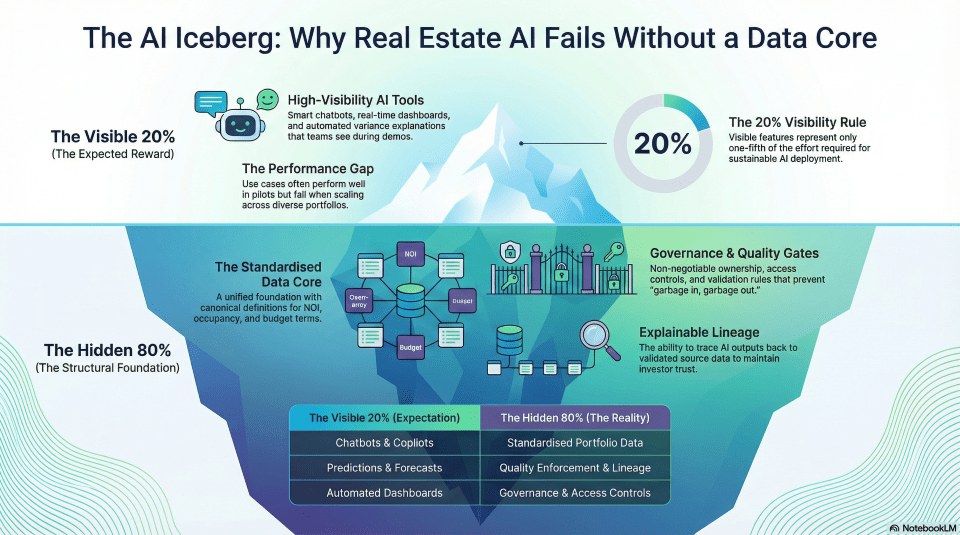
The AI Iceberg—What Leaders See vs. What Actually Matters
Most AI conversations focus on the visible 20 percent:
- Chatbots and copilots
- Predictions and forecasts
- Dashboards and automation
- Faster insights and decisions
But beneath the surface sits the hidden 80 percent, the foundation that determines whether AI survives contact with reality.
In real estate, that hidden layer consists of:
- Standardized portfolio data
- Consistent definitions
- Reliable historical records
- Quality enforcement
- Governance and access control
AI features sit on governance.
Governance sits on data.
If the data fractures, everything above it collapses.
Why AI Governance Fails Without a Data Core
AI governance is essential. Ownership, approval workflows, monitoring, lineage, and compliance become non-negotiable once AI reaches production.
But governance assumes something most real estate organizations do not yet have:
A unified, standardized, and trusted data foundation.
You cannot govern what you cannot standardize.
You cannot standardize what you have not unified.
In practice, many governance failures are actually data architecture failures in disguise.
Six Reasons AI Adoption in Real Estate Fails Without a Strong Data Core
- Garbage in, garbage out—at scale
AI amplifies inconsistencies. Inaccurate rent rolls, mismapped GLs, or incomplete histories quickly become confident-looking but unreliable outputs. - No shared definitions
Without canonical definitions for NOI, occupancy, budgets, or lease terms, AI has no stable concepts to learn from. - Fragmented systems
AI depends on feedback loops. Fragmented ERPs, spreadsheets, and multiple property manager exports break repeatability and trust. - Security and permissions risk
AI increases accessibility. Without entity- and fund-level security enforced in the data layer, AI becomes a governance liability. - Outputs cannot be explained or defended
If results cannot be traced back to validated source data, confidence disappears—especially in investor-facing contexts. - AI becomes a cost center
Manual fixes, reconciliations, and overrides turn AI into more work, not less.
What a Strong Data Core Looks Like in Practice
A production-ready data core for institutional real estate owners typically includes:
- Automated ingestion from property managers and systems
- Canonical data models and mappings
- Validation and reconciliation rules
- Time-consistent historical datasets
- Role-based access and security
- Clear data ownership and lineage
This is the layer that enables analytics, governance, and AI to coexist safely.
A Practical AI-Ready Roadmap
- Step 1: Select AI use cases that share the same core data
- Step 2: Define canonical models for only what is required
- Step 3: Implement quality gates before AI touches data
- Step 4: Establish governance early, not retroactively
- Step 5: Instrument pipelines to monitor drift and change
This avoids big-bang programs while still enabling scale.
The Real Takeaway
AI is not the transformation.
It is the reward for discipline.
Organizations that see real AI outcomes in real estate are not starting with copilots.
They are starting with data foundations.
A strong data core enables governance.
Governance enables trust.
Trust enables scale.
That is why AI adoption in real estate fails without a strong data core.
For more information about our approach to investor reporting and building AI-ready data foundations, feel free to reach out. We’d love to chat about how CREx Software can help.