
Written By: Dr. Dave Rogers
Why the Real Estate Investor Data Cube Matters
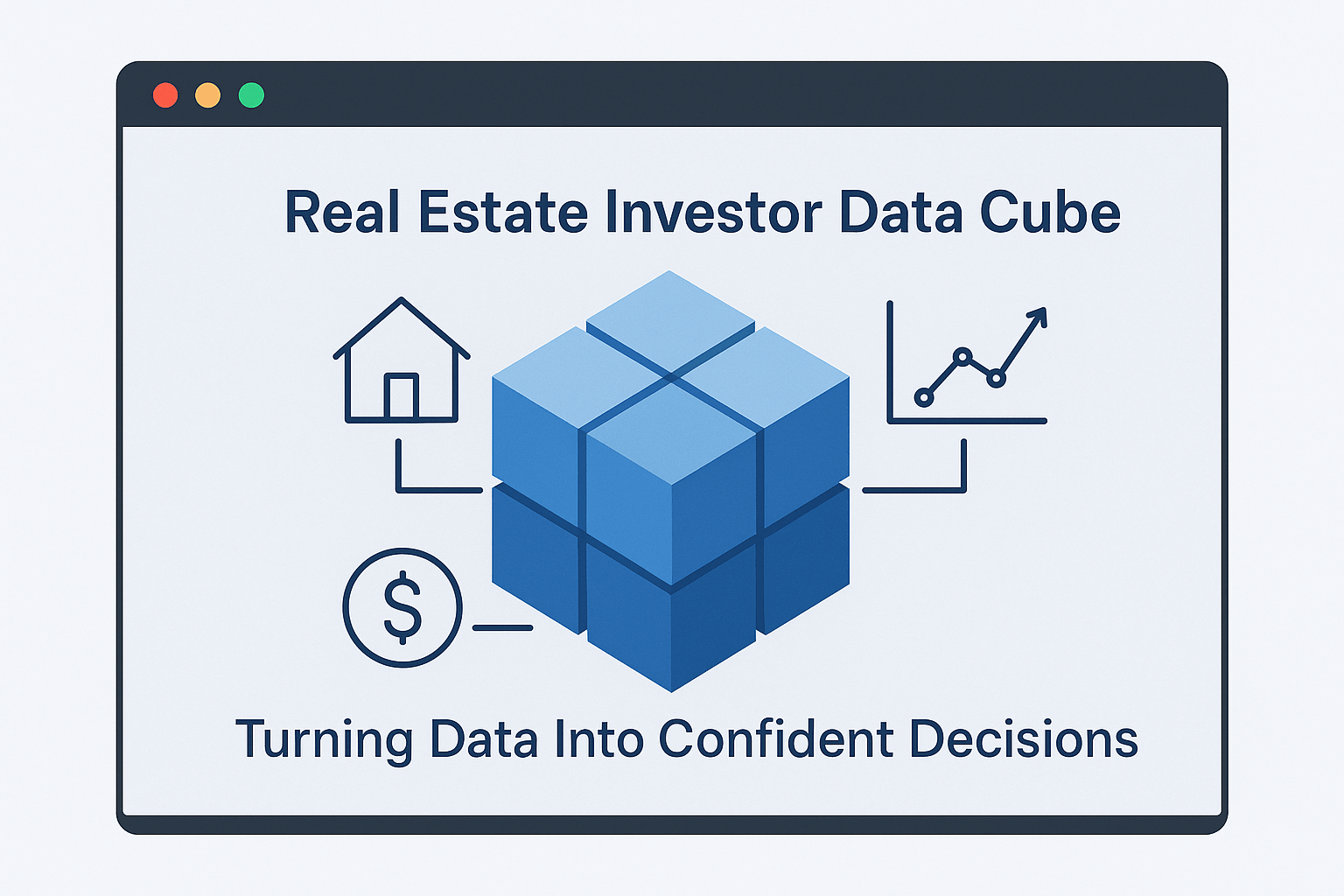
Real estate investing has always been about timing, intuition, and sharp analysis. But in today’s market, where data comes from property management systems, broker feeds, public records, financial systems, and demographic sources, intuition alone isn’t enough. Investors are flooded with information, yet they often struggle with the most basic questions: Can I trust this number? Is everyone on the same page? How quickly can I get the insights I need?
This is where the Real Estate Investor Data Cube comes in.
A Smarter Way to See Your Portfolio
Think of the Data Cube as your portfolio’s command center. It’s not another static report or one-off dashboard. It’s a curated, high-quality foundation of data that investors can explore from any angle.
For example, you can:
- View performance by city, asset class, or acquisition date.
- Drill into NOI trends or occupancy rates across your portfolio.
With the Real Estate Investor Data Cube, investors gain a consistent, reliable way to explore their portfolio.
Why Curated Data Changes the Game
Raw data often creates more problems than it solves. Numbers don’t match, and definitions vary (for instance, one person’s “vacancy” isn’t the same as another’s). When investors don’t trust the data, they hesitate, and hesitation costs money.
The Real Estate Investor Data Cube solves this by:
- Cleaning and standardizing messy inputs.
- Agreeing on consistent definitions (so NOI, cap rate, and occupancy mean the same thing across the organization).
- Delivering confidence that the numbers are right the first time.
This shift transforms data from a source of doubt into a competitive advantage.
Empowering Investors, Not Just Analysts
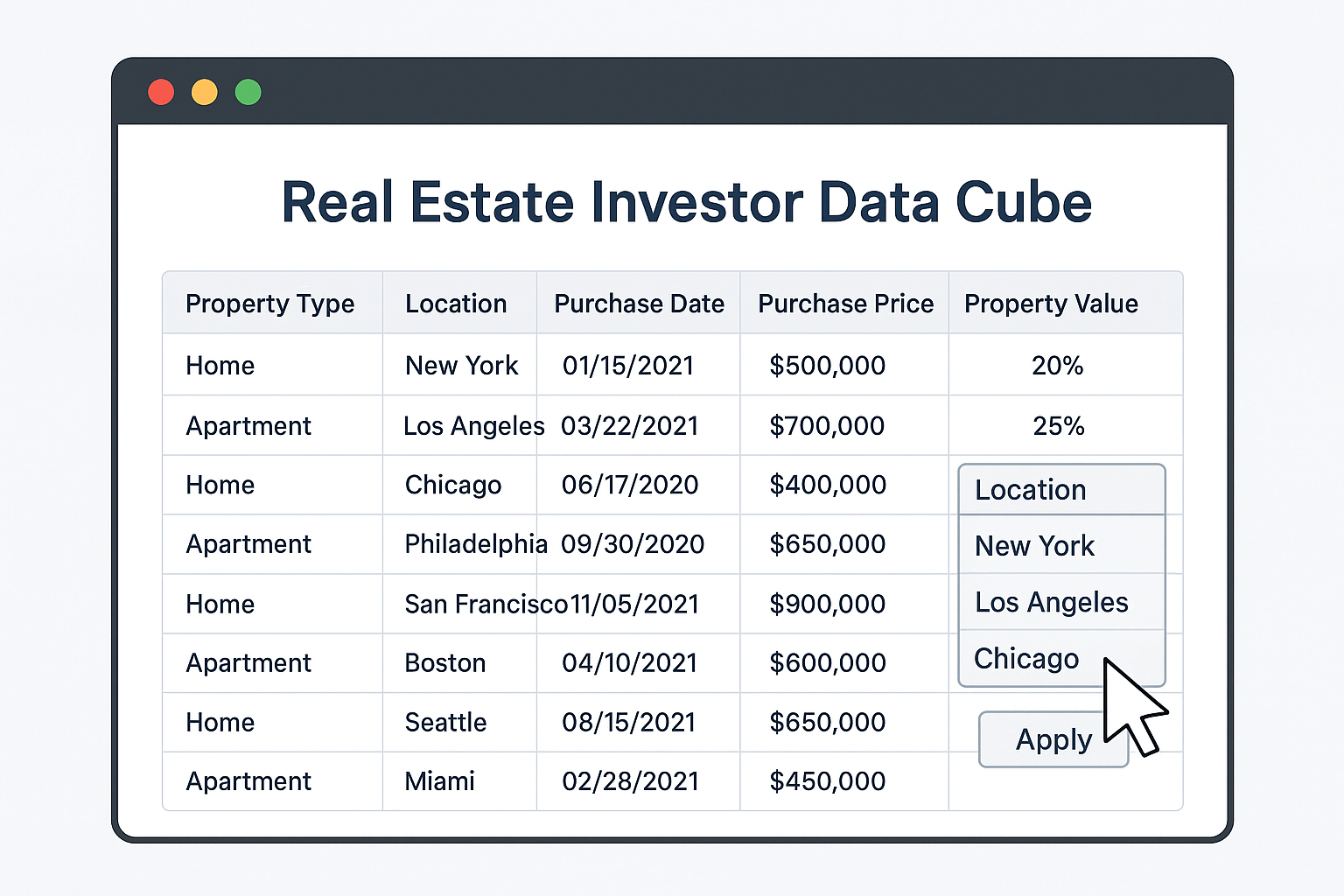
In many firms, data still sits behind bottlenecks: IT teams, analysts, or consultants who act as gatekeepers. The Data Cube changes that. It puts reliable insights directly in the hands of asset managers, acquisitions teams, and executives.
- Asset managers can instantly benchmark Class A multifamily across markets.
- Deal teams can model rent growth against operating costs before bidding.
- Executives can drill from top-level portfolio returns down to the performance of a single property…without waiting days for a report.
The result? Faster answers, greater agility, and more confident decisions.
The Business Payoff of the Real Estate Investor Data Cube
For real estate investors, speed and clarity are everything. The Data Cube delivers both. Firms that adopt this approach see:
- Decisions made in minutes, not weeks.
- Better alignment across teams, since everyone works from the same trusted numbers.
- More time spent on strategy, not reconciling spreadsheets.
- Scalable growth, as reporting keeps up with portfolio expansion.
Tools That Power the Real Estate Investor Data Cube
The good news: you don’t have to build this from scratch. Several proven tools support cube-based analytics today, including:
- Microsoft Analysis Services (SSAS) and Power BI
- Tableau and Qlik Sense
- Oracle Essbase and SAP BW/4HANA
- Modern cloud data platforms like Snowflake, Azure Synapse, Google BigQuery, and AWS Redshift (which integrate with cube-like models and BI tools).
Final Word: A Strategic Advantage for Real Estate Investors
The Real Estate Investor Data Cube isn’t just about technology, it’s about creating a single source of truth that builds confidence.
In a competitive market, firms that can explore their data quickly, trust it fully, and act decisively will be the ones that win. For real estate investors, the Data Cube is more than an analytical tool, it’s a strategic advantage.