
Getting Data from Fund Managers
Getting data from fund managers has always been a tricky topic, but with tools like CREx, this has largely been solved on the property management side. Most owners today can reliably access property-level financial and operational data.
The second part of the equation, however, is often more challenging: centralizing fund-level asset management financial data. To truly understand performance across portfolios, fund data needs to live alongside property data in one place.
Why Fund Manager Data Is Often Harder to Access
Many owners and asset managers work with third-party fund managers, which means critical data lives inside external systems and is often only shared through summarized monthly or quarterly reports.
So how do you actually get this data in a usable, structured way?
Before answering that, it helps to understand the core components of fund-level data.
Core Components of Fund Data
At a minimum, fund data typically includes:
- Fund transactions
- Investment management templates
- Transaction types
- A solid data model to store and relate all fund activity
With these pieces in place, owners can derive key insights such as:
- Capital activity (calls, contributions, distributions, and withdrawals)
- Investor ownership and capital account balances
- Fund-level and investor-level allocation mechanics
- Performance and return metrics
- Deal- or asset-level rollups used in investor reporting
This is the foundation required to move beyond static reporting and toward scalable fund analytics.
Common Fund Manager Systems and Data Access
Fund managers are usually third parties operating on platforms such as Yardi, MRI, SS&C, eFront, Investran, and similar systems. Obtaining data from these platforms is generally straightforward, but it does require coordination with the fund manager.
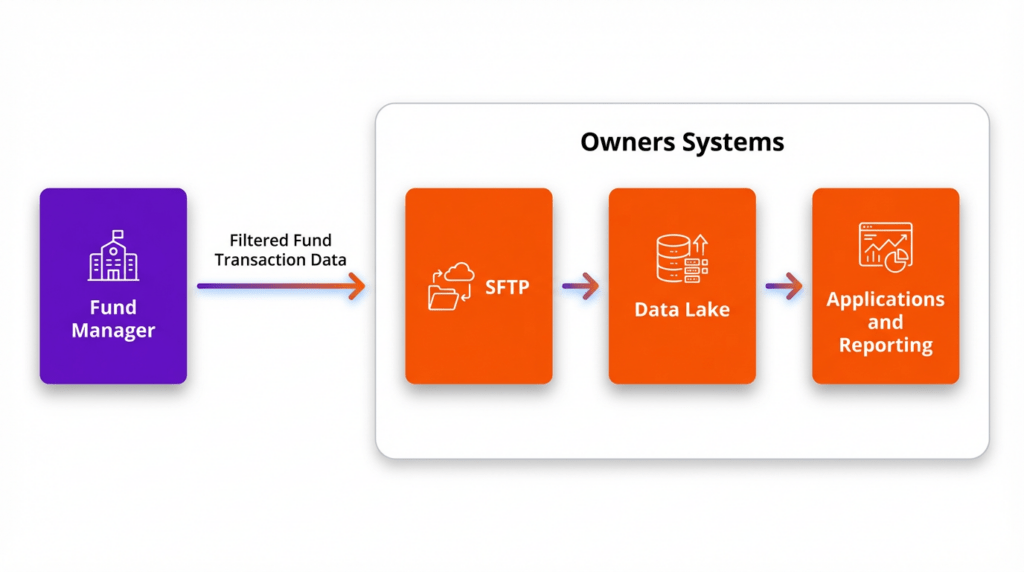
Because fund data is typically closed on a monthly or quarterly basis, daily feeds are rarely necessary. Instead, most firms set up automated exports to an SFTP location, which allows data to be collected consistently without manual effort.
It’s best to address data access during fund manager selection and contract negotiations. Most established fund managers already have processes in place to support this type of data sharing.
Filtering and Processing Fund Manager Data Correctly
One critical consideration is ensuring that exports are properly filtered at the fund manager level. Since fund managers support multiple owners, only your specific data should be included in each export.
Once the data lands in an owner-provided SFTP, it can be processed into a data lake and data warehouse. From there, owners can generate standardized reports such as:
- Fund-level performance summaries (NAV, contributions, distributions, IRR, equity multiple)
- Property-level rollups by fund (NOI, cash flow, valuation)
- Ownership and allocation schedules by property, entity, and investor
- Capital call and distribution history with full auditability
- Fund-to-property exposure and concentration analysis
- Hold period and realized vs. unrealized performance tracking
- Waterfall and promote inputs for downstream calculations
- Investor reporting inputs and standardized reporting views
This is where centralized fund data begins to unlock real value.
Tracking a Property’s Experience Across Funds
Another important nuance is understanding the fund’s experience of a property. While a property has a single acquisition date, it may move between funds over time.
Accurately capturing when a property exits one fund and enters another is essential to ensure performance, valuation, and returns are attributed correctly.
This is a detail that often gets lost without a well-defined data model.
Owner-Specific Data Still Matters
Not all required data points exist at the fund manager level. Certain owner-specific details must be recorded and maintained internally.
If there’s no formal system of record, Excel can work, but it introduces risk and version control issues. A platform like CREx OS is a far more reliable solution for storing and managing owner-controlled data points alongside fund and property data.
👉 Learn more about CREx’s approach to centralized real estate data at https://crexsoftware.com
Final Thoughts
Getting data from fund managers doesn’t need to be complicated, but it does need to be intentional. With the right processes, coordination, and data infrastructure, owners can centralize fund-level financials and unlock consistent, trusted reporting across their portfolios.
For more information on how to obtain and manage data from fund managers, feel free to reach out. We’d love to chat about how CREx Software can help.